Can Mobile Phone and Computer Displays Cause Obesity?
Why are there so many light sensors in adipose tissue?

Until today, I have always considered the influence of light only in terms of its direct effect on the functioning of enzymes in mitochondria. It is time to change that.
A strange question occurred to me, the one you see in the headline. Could modern LED displays on computers and mobile phones, with their limited emission spectrum, be causing not only the epidemic of myopia, but also metabolic problems and obesity? So I started investigating.
First, I asked artificial intelligence whether it happened to know anything about it:
AI quote
“Yes — OPN5 (opsin 5, neuropsin) has a demonstrable connection to the regulation of metabolism and thermogenesis, but so far mainly from experiments in mice. And interestingly, the connection with the thyroid gland was not directly confirmed in the key study.
What is known so far
OPN5 is a light-sensitive receptor. In the brain, specifically in the preoptic area of the hypothalamus, it is found on neurons that regulate body temperature. Activation of OPN5 by violet light (~380 nm) leads, through neural circuits, to suppression of thermogenesis in brown adipose tissue (BAT).
In mice lacking the Opn5 gene:
- brown adipose tissue activity was higher,
- they had higher energy expenditure,
- they produced more heat in the cold,
- they had increased expression of thermogenic genes such as UCP1, PRDM16, and PGC-1α,
- they had smaller white adipocytes,
- they exhibited certain changes in lipid metabolism.
So, simplified:
OPN5 activation → ↓ BAT thermogenesis → ↓ energy expenditure
whereas
absence/blockade of OPN5 → ↑ BAT thermogenesis → ↑ energy expenditure.”
End of AI quote
Aha, so the question is not completely off base, but it is somehow the opposite of what I thought. There are studies showing that blue light radiation (460 nm and 480 nm) activates lipolysis in adipose tissue directly through the activation of OPN3 and OPN4 receptors by illuminating the body of mice with blue light. This ensures sufficient fuel for thermogenesis in brown adipose tissue.

So I thought that near-ultraviolet and violet light would activate thermogenesis through neuropsin (OPN5), but it is the opposite. Violet and blue light act against each other just as in the previous post. It must all be related to the environment in which we once lived. Ultraviolet radiation from the sun is associated with infrared radiation, which provides heat. Perhaps we were not exposed to light sources in which these components of radiation were not linked. After all, even fire emits a small percentage of violet light. And when violet light is present, there is probably also infrared light, so brown adipose tissue can stop generating heat. It may also be more about changes, the dynamics of processes, and identifying day and night.

If we sit indoors all day at a computer behind tinted window glass that does not transmit violet or near-ultraviolet radiation, under artificial lighting, which also does not contain it, then our environment probably suppresses stimulation of neuropsin (OPN5). But that is apparently a simulation of nighttime during the day. This should therefore trigger higher thermogenesis, but other body regulatory systems will certainly detect this and begin using other sensors to synchronize with the circadian rhythm, using visible-light receptors — e.g., melanopsin.
But this substitute regulation may stop regulating thermogenesis in brown adipose tissue. Regulation by neuropsin will probably be bypassed. This could also mean a disruption of other regulatory mechanisms, for example the regulation of hunger and the associated excessive storage of energy as fat.
What if we stimulated neuropsin (OPN5) (e.g., through prolonged time spent outdoors or by supplementing a computer monitor with light from a small UV-A LED — this would need to be tested)? Regulation could be restored. Would it help us identify day and night? Indigo and near-UV light during the day may suppress thermogenesis, while its absence at night may increase thermogenesis. Its absence throughout the entire day will probably induce some average value, maintaining the same level of thermogenesis, which would mean suffering from heat during the day and suffering from cold at night. Neuropsin (OPN5) responds slowly and apparently differently from other opsins, non-electrically. The exposure therefore has to last for hours for an effect to appear.


 |
| Deactivation of the blue-sensitive photosensor OPN3 (Opn3 KO) suppresses fat and glucose burning and causes obesity in mice |
It is interesting that neuropsin (OPN5) is active not only in the skin and the retina of the eye, but also in areas hidden deep inside the body, e.g., in nerve cells in the brain, in the hypothalamus.
Similarly, OPN3 (encephalopsin) is deep inside adipose tissue. And yet a mouse cannot function without it. Without OPN3 activity, it is not possible to efficiently burn either fat or glucose. OPN3 is activated by blue or white light. Red light does nothing.
This really doesn't make much sense. Are there perhaps some special light guides in the body? Fibers that transmit blue light deep into the body? Then it would make sense, but I don't know of any. One could almost assume that some such fibers must exist.
You can also ask yourself how large the influence of photoreceptors is compared with the known effects of peroxidized polyunsaturated fats and fructose. I answered this once before: if we manage to burn off excess omega-6 linoleic acid before it becomes peroxidized, we avoid all the problems. However, inactive photoreceptors may slow the burning of polyunsaturated fats and thereby increase their peroxidation into HNE. It could therefore be the primary cause of the problems.
It is also interesting that it is always a pair of photoreceptors that act against each other, and the ratio of their activation makes it possible to distinguish night from day through the blue part of the visible spectrum. From an evolutionary perspective, it apparently was not appropriate to identify daytime solely by heat. It was probably more reliable to monitor the presence of violet light at the edge of the visible spectrum relative to the blue component of light. If we add blue or blue-green, it means night and thermogenesis; if we add violet, it means day and thermogenesis being switched off.
We probably are better off warming ourselves through movement during the day, rather than through activation of brown adipose tissue. But we have already eliminated these ancient signals anyway. We wear thick clothing, and our artificial light sources, which we use to replace daylight, do not contain the edge of the visible spectrum. This signaling cannot function properly in us today. And we apparently see the results all around us.
If you work at a computer and constantly look at an LCD display, it is certainly worth trying to supplement it with a small violet LED containing a 420 to 440 nm component. The spectrum should perhaps already start at 380 nm to stimulate OPN5 not only in the retina of the eye but also in the skin. If the lamp contains a filter to remove blue-violet light (which is better for detecting banknotes, but not for our purposes), then I would remove this filter.
 |
| Typical bandwidths of common LEDs. |
Addendum:
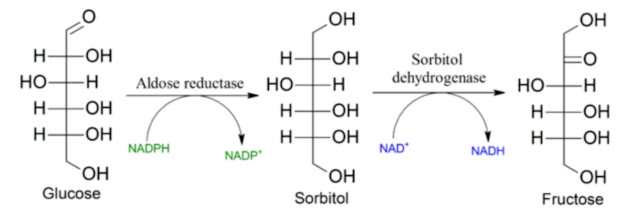
I also realized that the alleged harmfulness of blue light (but not violet) could actually be the effect of activation of the polyol pathway by excess free fatty acids released from adipose tissue through activation of the OPN3 photoreceptor, which will necessarily increase the level of insulin and unphosphorylated glucose in the cell plasma and, together with HNE (peroxidized linoleic acid), activate aldose reductase (AR), the first enzyme of the polyol pathway. If this is indeed the case, then supplementing with glycine would have a protective effect.
References:
Violet-light suppression of thermogenesis by opsin 5 hypothalamic neurons
Metabolic responses of light and taste receptors – unexpected actions of GPCRs in adipocytes
Cell-autonomous light sensitivity via Opsin3 regulates fuel utilization in brown adipocytes
A Retinal Ganglion Cell That Can Signal Irradiance Continuously for 10 Hours
A later addition—a comprehensive article on what could be known about light if it were properly investigated:
The Hidden Harms of Modern Lighting and the Fight to Bring Back Incandescent Bulbs


Comments
Post a Comment