Does glycine function as an AR inhibitor? Does it suppress endogenous fructose production?
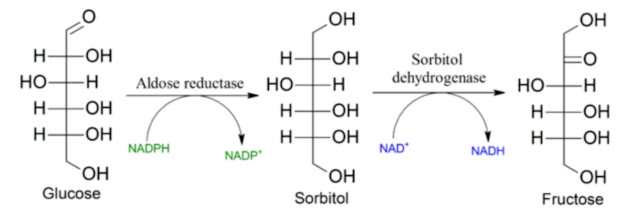
It occurred to me to start looking for a relationship between glycine supplementation and the polyol pathway, specifically whether glycine might have some relationship to the activity of aldose reductase (AR). This enzyme (together with fructokinase KHK) appears to be at the center of events related to obesity, oxidative stress, chronic inflammation, etc. Turning it off interrupts inflammatory signaling and the response to endotoxins, but it also disrupts the breakdown of certain toxins. Its inhibition therefore may not always be desirable.
And it seems to me that I have found a certain connection between glycine and AR. It is a rather innocent-looking cataract study in diabetic rats from 2019. The authors apparently had the same idea: what if glycine interacts with aldose reductase? And they tested it in diabetic rats. And it worked!
The study was conducted in such a way that at a certain point the rats’ pancreas was chemically damaged, so insulin production stopped. This leads to an immediate increase in blood glucose levels followed by gradual organ damage. This study focused on damage to the eye lens in the form of cataracts and examined the possibility of suppressing this damage by supplementing glycine in the diet. Two levels of supplementation were used (250 and 500 mg/kg, groups III and IV), each as a single oral dose daily for 45 days. Group I is a non-diabetic control, group II is a diabetic control, and group V is a control with AR blocked using the most common pharmaceutical AR blocker, sorbinil.

I have mentioned the amino acid glycine here many times already; for example, here I described how it reduces the formation of aldehydes from omega-6 polyunsaturated fatty acids and how it suppresses the formation of advanced glycation end products (AGEs). The mechanism is still somewhat unclear; it is assumed that the basic effect is that glycine, as a building block, helps with the formation of glutathione (GSH). It thus improves antioxidant protection. However, this mechanism seems to me to be only auxiliary; the core of the effects must lie elsewhere. It is probably more complicated.

For example, precisely in the rat cataract study we can compare glycine supplementation (groups III and IV) with direct AR blockage using sorbinil (group V). And the results are very comparable. It therefore appears that the mechanism could indeed be AR inhibition. It can be seen that even this alone is able to restore GSH levels, but it also changes glucose levels and insulin production. There must therefore have been partial regeneration of pancreatic beta cells. In the groups receiving glycine, the onset of cataracts is significantly delayed. This is most likely due to suppression of AR activity in the lens epithelium. High glucose levels increase AR activity, but glycine deactivates AR. Could some intermediate of glycine metabolism perhaps serve as an AR blocker? What AR blockers do we know that contain glycine?

Yes, such compounds do exist, for example Tolrestat (N-methylglycine). It is an effective inhibitor, but whether some similarly effective molecule is produced naturally during glycine supplementation, we do not know. The important thing is that it works.


We can also look at the results of an older study from 2012 with a very similar focus. The preventive effects of glycine against the development of cataracts are, in my opinion, clearly visible. The study was longer, lasting 12 weeks, and included four groups: non-diabetic control (N), diabetic control (D), diabetes plus glycine (DG), and non-diabetic with glycine (NG).

Glycine as a suppressor of the polyol pathway and oxidative stress can, together with acetate, quite substantially help correct metabolism disrupted, for example, by the aldehyde 4-HNE—that is, aldehydes formed by peroxidation of seed oils, primarily from omega-6 linoleic acid. This is a very important finding; now it just remains to verify it in a human population and put it into practice, right?
References:
Glycine therapy inhibits the progression of cataract in streptozotocin-induced diabetic rats
In Search of Differential Inhibitors of Aldose Reductase


I've been thinking about this. Having taken glycine for awhile now for non aldose reductase reasons. I don't feel like i've seen the benefit to AR like I should. I tried looking for half-lifes for possible AR inhibitors. Because I wonder if constant doses throughout the day are going to be necessary, and how large those doses need to be.
ReplyDeleteSorbinil has a long elimination half-life of 38–52 hours, Tolrestat 10–12 hours, Epalrestat ~1.7 hours (102.5 min), and AT-001 1.7–3.3 hours.
Average terminal half-life of 3.5 h for quercetin.
Curcumin has a relatively short blood half-life, typically ranging from 3 to 7 hours for total metabolized curcumin in human plasma. While often cited as having poor bioavailability with a rapid, minutes-long, or few-hour half-life due to fast metabolism
The blood half-life of glycine is dose-dependent, typically ranging from 26 to 245 minutes (approximately 0.5 to 6 hours)
Natural sources reported to inhibit aldose reductase include Indian gooseberry, spinach, cumin seeds, fennel seeds, basil leaves, lemon, black pepper, orange, curry leaves, cannabis,[2] cinnamon[3] and lichen.[4][5] Luteolin, a type of flavonoid found mostly in leaves, and their synthetic derivatives are potential inhibitors of aldose reductase
Actually there was a time I had an orange 2-3 times a day and saw other good results. I didn't know at the time it was a possible AR inhibitor. Just doing it from a low protein POV
Doing the human math for 500 mg/kg glycine, That's 8g/d for somewhat overweight individual, and up to 16g/d for very obese. Not 3-5g I see often in health circles. Though I know one guy who recommends 10+ because the body needs 30g but recycles 10g, and we eat 10 normally.
ReplyDeleteThough I wonder if a sorbinil prescription is easier. But it has not been shown to cause weight loss in studies.
Regarding weight loss, AR inhibition reduces endogenous fructose production. For low fat storage you also need to eliminate ditery fructose.
Delete