Which amino acid suppresses chronic inflammation?
Many readers already of course suspect which amino acid it might be, but I’ll leave that for later.

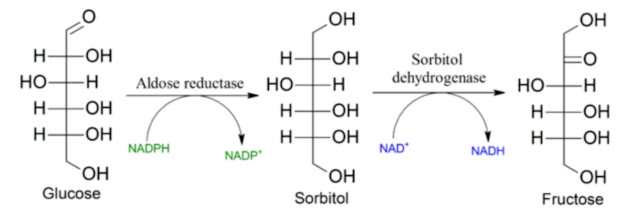
It is becoming increasingly clear that the main problem of modern civilization diseases could be one relatively little-known, but in our time overly active enzyme. You already know it from previous posts: aldose reductase AR, the beginning of the polyol pathway. Yes, it is the enzyme that converts glucose into sorbitol and subsequently the enzyme SORD breaks it down by converting it into fructose. It is also the enzyme that processes 4-HNE, an aldehyde derived from the omega-6 linoleic acid, into active inflammatory signaling molecules. I have already shown here how sorbinil, an AR inhibitor, completely suppresses inflammation signaling caused by LPS, i.e., bacterial endotoxins. Switching off AR interrupts signaling to other cells; no chronic tissue inflammation then takes place. This may be good in the case of inflammation activation by dead material such as LPS. It may not be so good during a bacterial infection, I don’t know. In any case, we could now easily control it, suppress it or not as needed; we can decide. All that is needed is to find a suitable AR inhibitor.

As you already know from the previous post, I searched further and found that the common amino acid glycine is also somehow involved in AR inhibition. It is enough to supplement rats with glycine in the diet (for example 1 to 2% in drinking water), and AR is blocked practically in the same way by glycine as it is blocked by sorbinil. So I kept digging and found a number of studies where we can see the effects of suppressing AR function. In addition, glycine also acts directly via glycine and NMDA receptors on the nervous system and on muscle cells, so it is able to prevent muscle breakdown during caloric deficit and perhaps even suppress appetite, but more on that some other time.

First, we will show, using data from one study, that rats can be obese from a high-fat diet (HFD, again the usual D12492), yet still retain insulin sensitivity. Don’t believe it? Just switch off inflammation signaling as I described in the previous paragraph—using glycine. Notice the graphs at the bottom of the previous image. In all of them, the HFD-Gly bar is the same as ND-Ala and ND-Gly, that is, with a low-fat diet. What does that mean? A high-fat diet supplemented with glycine does not cause inflammation! Not even with the same amount of fats and cholesterol in the blood as in the case of another high-fat diet, HFD-Ala! Even when it contains seed oils!

The rats were not lean at all even with glycine supplementation in the diet (Body weight); the amount of adipose tissue was practically comparable (Adipocyte index). But insulin sensitivity and the response to the glucose test (AUC) are much better. Switching off inflammation signaling preserves the functionality of many cells, mainly in the digestive system, in the liver, in adipose tissue, but it does not eliminate obesity.

From what I have described, it is clear that if, under these circumstances, we wanted to reduce obesity in rats, we would have to exclude fructose from the diet in addition to blocking AR (D12492 diet contains approx. 3.5% fructose). Only then would KHK be deactivated and the function of SIRT2, SIRT1, and AMPK restored. A similar service—namely suppressing the effects of fructose—is also provided by acetic acid, sodium acetate, vinegar. So a combination of vinegar with glycine could probably be much more effective than vinegar alone or glycine alone. Now it just remains to test it. I personally take about one teaspoon of glycine per day, but for suppressing chronic inflammation it is probably more effective to take more, perhaps up to 4 teaspoons. Maybe that is also why supplementing vinegar and glucose was relatively effective for me.


References:
Glycine therapy inhibits the progression of cataract in streptozotocin-induced diabetic rats
Aldose reductase inhibition suppresses oxidative stress-induced inflammatory disorders


Comments
Post a Comment