Do You Know That Without Oleic Acid, Fats Cannot Be Stored?
You probably suspect that fats only begin to be stored once a signal for their storage appears in the body. But what exactly is that signal? Do we know?
In an earlier post, I already searched for the answer to this question, and I believe I found it. It involved the formation of triglycerides in the liver and their export throughout the body in the form of VLDL particles. For the formation and export of fats from the liver, oxidative stress is required—specifically hydrogen peroxide (H2O2)—and oleic acid (OA).

This time, we will look at fat storage in adipose tissue, in subcutaneous (SWAT) and organ (visceral, EWAT) fat. It might seem that storing fat is easy. That it does not matter which fats are available. After all, it should be enough to raise insulin levels and fat will store itself, right? But it really does not work that easily. Without oleic acid, you will not store any fats! Truly! And moreover, the association with insulin levels also somehow does not work (mice, 3 days on a high-fat diet). At least with regard to the increase in the number of newly differentiated fat cells. What is going on?

It seems paradoxical—after all, professors tell us that saturated fats cause obesity, right? Others claim that polyunsaturated fats are responsible for fat storage, specifically omega-6 linoleic acid. But studies tell us that it is precisely and exclusively oleic acid that activates triglyceride formation, the only form of fat that can be stored. And now we have another study that basically says the same about fat cells, adipocytes (APCs). Without oleic acid, it is supposedly not even possible to increase the number of fat cells. It even claims that different insulin levels have no effect on the number of new fat cells.
So how is it? Something does not add up! Let us try to untangle this and give these findings broader meaning.
We can resolve the first paradox easily. We already know that fast and easy fat storage is beneficial. It improves blood markers, allows food to be processed quickly, and thus stores energy for later. It prevents cells from being overloaded with fuel and preserves their insulin sensitivity. Adipose tissue can then serve as needed—when storage is required, it stores; when energy release is required, it releases fats from reserves. Therefore, if oleic acid facilitates fat storage, it is not a problem, as it might seem at first glance.

However, the study on fat cells tells us that we have two ways of storing fat: hypertrophy and hyperplasia. Hypertrophy is the enlargement of fat cells without a change in their number. Hyperplasia is the increase in the number of differentiated fat cells (Proliferation + Differentiation). This means that preadipocytes differentiate into new functional fat cells.
It is commonly stated that hypertrophy—the enlargement of fat cells—is problematic. It leads to worsening blood markers, whereas hyperplasia is associated with obesity without complications, without deterioration of blood markers.
In this study, they see it somewhat differently. Cell enlargement seems to them to be less of a problem than the formation of new fat cells and the increase in the total number of differentiated fat cells. They claim that an increased number of cells is responsible for a more permanent enlargement of adipose tissue. Are they right? Is it really better to enlarge cells than to increase their number so they can remain small?
To decide what is better, it is necessary to consider the broader context. I believe the authors did not take cellular senescence into account. We already know that the differentiation phase of fat cells generates oxidative stress—hydrogen peroxide. Unmanaged oxidative stress creates senescent stem cells, and hyperplasia then leads to dysfunctional adipose tissue. But that is not the normal state. If the tissue is protected, for example by acetate, which activates the deacetylase SIRT1, then no cellular senescence occurs. I believe this is how it should work—so that when fat storage is necessary, we can increase the number of cells and ensure that the cells remain small and well-functioning. Small cells have the best surface-to-volume ratio. Hyperplasia is therefore problematic only in conditions of overload, in a situation of insufficient antioxidant protection. From this perspective, this study is very interesting because it shows how hyperplasia is triggered—that is, the increase in the number of newly differentiated fat cells.

Let us also recall this. The rate of fat processing or release is directly proportional to active surface area, not volume. Cells that are half the size provide, at the same volume of adipose tissue, twice the active surface area. I believe that the volume of adipose tissue does not form randomly. It is determined by the body’s needs—the need to store calories quickly. Large fat cells are inefficient; adipose tissue must be much more voluminous to provide the same activity, the same rate. That, I think, is the reason for increasing adipose tissue volume. If the body cannot cope, if it does not know where to store calories, it differentiates new fat cells.
And it turns out that oleic acid is the main signal. If it cannot be stored quickly enough, new fat cells differentiate. But to be fully functional, the H2O2 generated in the process must be properly neutralized by antioxidant protection. That requires high activity of the deacetylase SIRT1; otherwise dysfunctional, senescent adipose tissue develops. This completely changes the view of what is good and what is bad. Don’t you think?

So what were the findings of the study? The authors focused on determining how proliferation and differentiation of new fat cells are activated—how the increase in the number of fat cells is activated. And they found that it is controlled by the presence of oleic acid. No other fatty acid increases the number of fat cells. They first compared different fat compositions and then directly used trioleate, a triglyceride containing only oleic acid. Other fats have practically no effect. Oleic acid activates AKT2 phosphorylation and the effect of insulin.
Unlike the study authors, I consider this phenomenon to be normal. If it is fully functional, I consider it beneficial. Calories simply need to be stored safely, and new fat cells also serve this purpose. The fact that excess calories are stored is not wrong. However, if adipose tissue is damaged in the process, then this phenomenon can become negative. The problem therefore lies rather in ensuring conditions under which adipose tissue is not damaged. My opinion.

What is the specific mechanism? The study authors examined whether fat receptors (G-protein receptors, FFAR) might be involved. Specifically, they investigated the influence of GPR120 and GPR40, but found no effect. Knockout (KO) of the receptors did not eliminate the increased activation of proliferation (%BrdU+ APCs) by oleic acid (HFD). The pathway of oleic-acid-induced proliferation activation proceeds via increased AKT2 phosphorylation and decreased LXRα phosphorylation.

Conclusion? Without oleic acid and hydrogen peroxide, excess calories cannot be stored in adipose tissue. Our concern should not be to limit fat storage, but to ensure that it proceeds safely—under strong antioxidant protection. This can be ensured by sufficient activity of NADPH-producing enzymes, their deacetylation via SIRT1. Adequate NADPH enables GSH recycling—precisely the antioxidant protection that is required.
References:
Dietary oleic acid drives obesogenic adipogenesis via modulation of LXRα signaling
Changes in Lipolytic Activity of Isolated Adipocytes from Rats throughout Life Span

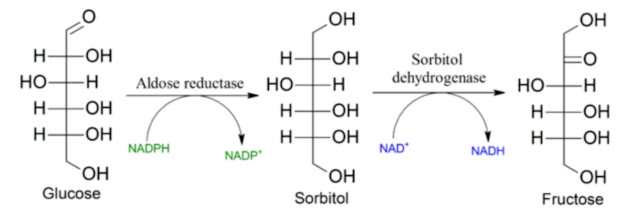

To your last paragraph. NADPH from Glucose is one mechanism you've studied. And that is inhibited by linoleic acid. I can't help but think that linoleic acid and Oleic acid are going to be found together in many foods, the way industrialized oils are used. thoughts?
ReplyDeleteAlso, I read mainly on my phone and can't make comments there. But rest assured I'm reading every article multiple times.
Together linoleic and oleic acid make perfect obesogenic mix if antioxidant protection is impaired, e.g. by fructose. Linoleic acid elevates ROS even more and oleic acid activates storage. More linoleic and less oleic acid makes it probably less obesogenic, paradoxically. But this process is triggered by low antioxidant protection, so it's not necessary unavoidable.
Delete