Posts

Showing posts with the label breathing

Does the Umami Taste Activate a Signal of Essential Amino Acid Deficiency?

Image
Let’s continue searching for the source of obesity and metabolic disorders. In the series “ Who will tell us we have eaten enough food ”. I explored the mechanisms by which the body regulates food intake. What determines that the food we’ve eaten isn’t enough and we need to eat more? My conclusions are fairly simple. During the day, we collect food to have enough energy for sleep. Control is carried out through liver glycogen — during the day, we burn and store different forms of food in various tissues, and in the end, there has to be something left. This leftover of carbohydrates and amino acids is converted into liver glycogen. After a day’s consumption, there must be enough glycogen for rest and sleep. I think this is the basic energy regulation. But sufficient energy is not enough for survival. A lack of essential amino acids leads to premature death in mice . That’s probably why there are auxiliary mechanisms — for example, one that ensures sufficient essential amino acids, worki...
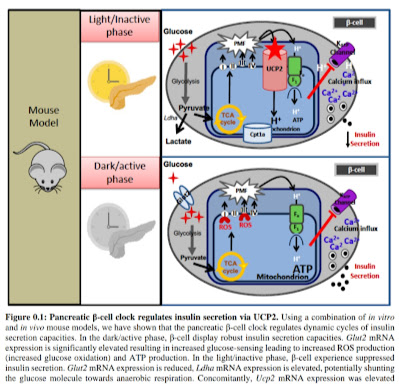
What is mitochondrial uncoupling, and is it good or bad?

Image
If we imagine the mitochondria as a steam power plant with a steam boiler and a generator, then we could compare mitochondrial uncoupling to a safety valve on a steam boiler. If we use a lot of electricity, everything runs as it should. But if we don't need electricity, we have to reduce the energy input to the generator. The pressure inside the steam boiler starts to rise and we have to let some of the steam out so that the boiler doesn't crash. In the mitochondrion, the electrical generator is complex V and the steam boiler is the inner mitochondrial membrane, where electrical voltage is created and maintained with the help of complexes I to IV. The discharge of voltage occurs precisely at complex V, where ATP molecules are formed. Mitochondrial uncoupling proteins (UCP) ensure controlled voltage discharge so that mitochondria are not damaged. There are two of these proteins/enzymes, UCP1 and UCP2. We will be interested in UCP2, because it is practically in every tissue, in e...

Can Vinegar Be the Solution to Alzheimer's and Senile Dementia?

Image
Vinegar or acetate is a very interesting substance, a food supplement. If you would like to know more and in detail about it and its metabolism in the body, read this two-part article . It is devoted to acetate only and has two parts, a total of 49 densely annotated pages in two columns. All this about a molecule that contains only two carbons. Incredible. It apparently affects all processes in the body. Acetate acts not only by activating AMPK during its conversion to acetyl-CoA, but also directly on the FFAR2 receptor, thus, for example, it supports vasodilation, i.e. better blood and oxygen supply to tissues. First, let's review the basic mechanism by which acetate in the body acts against obesity. It is the result of the processes associated with the activation of acetate in the cell, i.e. the connection with the CoA molecule to form acetyl-CoA. This reaction consumes energy (ATP) and creates a signal of shortage, activates the enzyme AMPK, which limits the ACC enzyme by phosp...

Beware of hypoxic fat cells, they spread cancer!

Image
As I wrote elsewhere, when I add the transcription factor HIF-1α to the search, activator of (pseudo)hypoxia, activator of metabolism without the use of oxygen, something interesting always appears in the results. So this time it's quite the bomb. Fat cells spread cancer by spreading the message of lack of oxygen. The study does not say it directly, but if we consider that the activation of the transcription factor HIF-1α is behind the hypertrophy of fat cells , i.e. their constant enlargement to enormous dimensions, then it is not surprising that these cells spread many problematic signals around the body. One such little-known signal is small extracellular vesicles called exosomes. Extracellular vesicles containing regulatory signals sent by fat cells. I have already shown several times here that the activation of (pseudo)hypoxia, i.e. the transcription factor HIF-1α in adipose tissue, is at the beginning of subsequent changes in the entire organism. Studies in mice show that if ...

Is photobiomodulation better with red, green, blue or white light?

Image
We have already seen the healing power of red light . Let's review what it can do. According to the latest research, red light passes through the skin into the tissues, even through the bones. It acts through nitric oxide (NO), probably by producing NO from nitrites by the enzyme CcO, which limits oxidation on the fourth mitochondrial complex CcO. This leads to a better distribution of oxygen throughout the tissue, resting oxidation improves, i.e. obtaining energy from food in the most efficient way through oxidative phosphorylation. But it's not a cure-all. This is because oxidation will not increase under load. Nitric oxide conserves oxygen and promotes the fermentation of glucose to lactate. Thus, energy in the form of ATP molecules is increased, but their origin is largely from glycolysis, not from oxidative phosphorylation. Let's try to find an even better solution, for example, we can look at what other colors of light or combinations of several colors do. Different w...

Is coconut oil safe? What about soy or olive?

Image
How does coconut oil compare to other vegetable oils? Someone recently argued on the X network a study comparing coconut, olive, and soybean oil in a mouse model of obesity. The conclusions of the study are that one would not take coconut oil by mouth. It is true that I also point out here that coconut oil contains mainly lauric acid C12:0, which can cause fatty liver because it strongly suppresses lipolysis and allows, unlike shorter fatty acids, fat storage in the liver.  But it is also a way to clean the blood from free fatty acids, which modify the metabolism of the entire organism. Let's analyze the data from this study preprint  a little while knowing the IR 2.0 model and you will see that things can be a little different than the way the authors present them. In addition, they provide us with further arguments by giving fat in two amounts, such as 7% or 21% of the food. In addition, they performed this on two types of mice, mice with active and disabled peroxisomes (us...

Insulin resistance 2.0

Image
Insulin resistance is only an emergency. Imagine that you are driving a car and you step on the gas (insulin). You expect an increase in engine speed, acceleration, but nothing. A red light on the dashboard lights up and the car goes into emergency mode (activates HIF-1α). Why IR 2.0? Because this post is a loose follow-up to the post on insulin resistance , which quite knowingly and controversially states that we lack hydrogen peroxide. Well, it is not quite true, rather  we lack oxygen in the tissues, CO2 ,  nitrites ,  ground-level ozone  or  light , but it is correct to state that hydrogen peroxide works against insulin resistance. The controversial part is that you'll hear everywhere how ROS, free radicals, cause insulin resistance, and I say that hydrogen peroxide lets glucose into the cells. I am not alone. Recently, in a similar vein, the well-known blogger Petro Dobromylskyj published a series of articles entitled Insulin mimesis . There he shows how v...