Can the liver be saved by blocking AR?
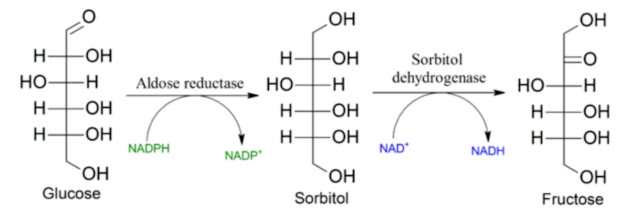
What is AR? It is the enzyme aldose reductase. An enzyme that processes excessive cytosolic glucose into sorbitol. Before we look at a study involving AR, let us first look at what is required for fat formation in the liver. Also see an older post on the same topic.
In the first study, we see that activation of the enzyme SCD1 is required for fat storage in the liver. Without it, this cannot occur. This enzyme desaturates longer saturated fats, namely palmitic acid and stearic acid, into monounsaturated fatty acids. Since palmitic acid C16:0 is formed mainly by de novo lipogenesis from acetyl-CoA molecules, it is at the same time rapidly elongated to stearic acid C18:0 and further desaturated by the enzyme SCD1 to oleic acid C18:1. Perhaps it is not so much about the desaturating enzyme SCD1 itself, but rather about the presence of oleic acid C18:1. This fatty acid is absolutely essential for fat storage in triglycerides. So essential that shutting down desaturation prevents fat storage. However, if oleic acid C18:1 is present, for example from fat stores or from the diet, disabling desaturation (SCD1 -/-) does not slow down lipogenesis.

Interestingly, other fatty acids do not support lipogenesis when desaturation is disabled (SCD1 -/-); only the monounsaturated oleic acid C18:1 does. Neither stearic acid C18:0 nor linoleic acid C18:2.

Another interesting point is that SCD1, and thus oleic acid as well, is required for the storage of liver glycogen from fructose. It is therefore required not only for the initiation of de novo lipogenesis but also for the initiation of gluconeogenesis, which allows partially processed fructose to be converted into glucose and stored as glycogen. Removing SCD1 therefore is probably not the best method to prevent lipogenesis. It could cause accumulation of fructose and increased production of uric acid, which is probably not desirable.

When we look at the time course, both glucose and fructose are able to rapidly restore liver glycogen levels, but fructose does so with approximately a one-hour delay. An increase in glucose after fructose administration is not observed, but from the curve of rising glycogen levels it is clear that fructose administration does not suppress gluconeogenesis, whereas glucose does suppress it, because gluconeogenesis then becomes unnecessary.

It is precisely the first hour of gluconeogenesis after administration of a high dose of fructose that produces the required glucose, which subsequently suppresses gluconeogenesis and then restores it again. This can be seen in the time course of G6Pase and PEPCK expression.

Let us now look at the time course of SCD1 activation in diabetic mice, that is, without endogenous insulin production. This model allows the effects of glucose, fructose, and insulin to be observed separately.

Why is activation of SCD1 by insulin practically immediate, whereas activation by fructose is delayed by as much as 12 hours? Is fructose a poor activator of lipogenesis? Is cytosolic glucose a better activator? Does fructose activate lipogenesis directly or through some other process? From the previous paragraphs and figures it is clear that fructose alone is indeed not sufficient. Oleic acid is also required. Where does it come from? It is produced from cytosolic glucose. Once a sufficient amount of oleic acid is produced, lipogenesis accelerates greatly through activation of SCD1. If glucose is outside the cell (without insulin), lipogenesis does not occur; fructose does initiate lipogenesis, but far from at the maximal rate. Without insulin, the glucose needed for the production of oleic acid must first be generated by gluconeogenesis and subsequently by lipogenesis. And that takes some time, approximately 12 hours. Only then is SCD1 fully activated.
Let us summarize. Rapid fat formation is not a negative thing if it takes place in an environment with sufficient antioxidant protection. It is a process that stores excessive fats and carbohydrates into triglycerides, which are the only safe product. The faster this occurs, the fewer excessive fuels remain in the bloodstream. From the liver, triglycerides must be rapidly exported in the form of VLDL lipoprotein particles to the rest of the body, either for direct combustion into heat, for ATP production, or for storage for later use. This is handled by muscles and adipose tissue.
The source of fructose, in addition to food, is mainly glucose endogenously converted into fructose in the liver via the polyol pathway, through the activity of the enzyme AR, especially in conditions of glucose excess and high insulin levels. The source of oleic acid, in addition to the diet, is also glucose as a substrate for de novo lipogenesis, via SCD1 activity. It is often likely produced by gluconeogenesis as well under low insulin levels. This, among other things, refutes the notion that fats cannot be produced without insulin. Fructose alone is sufficient, as it is able to arrange everything necessary, producing H₂O₂ instead of insulin by suppressing antioxidant protection. This serves as an activator of fat formation in place of insulin.
If in a given situation we want to shut down fat storage in the liver, for example because fats cannot be exported or because the body no longer wants to accept them, it is sufficient to suppress the effect of fructose (KHK KO) or oleic acid (SCD1 -/-). But how does the enzyme AR, whose suppression also prevents fat formation, fit into all of this? You probably already suspect the answer: suppression of AR shuts down endogenous fructose production, thereby shutting down de novo lipogenesis, and in addition suppresses endotoxin poisoning from a leaky intestinal wall and suppresses protein glycation. See posts on this blog devoted to the effects of glycine; it is also an aldose reductase inhibitor. (ARI)

This study may also help us understand the effects of AR inhibition (ARI).
Citation
"In parallel with successful treatment of steatosis, AR inhibitor suppressed ethanol-activated galactose metabolism and saturated fatty acid biosynthesis. Sorbitol in galactose metabolism and stearic acid in saturated fatty acid biosynthesis were potential biomarkers responsible for ethanol or ethanol plus AR inhibitor treatment. In vitro analysis confirmed that exogenous addition of sorbitol augmented ethanol-induced steatosis and stearic acid. These findings not only reveal metabolic patterns associated with disease and treatment, but also shed light on functional biomarkers contribute to AR inhibition therapy."

 |
| Is it sorbitol that causes alcohol liver damage? |
References:
Dietary oleic acid drives obesogenic adipogenesis via modulation of LXRα signaling
Insulin and dietary fructose induce stearoyl-CoA desaturase 1 gene expression of diabetic mice


Comments
Post a Comment