Glycine as a fighter against lipid peroxidation?
The amino acid glycine is a commonly available dietary supplement for athletes. I have been using it for quite a long time. I do not know whether it really works, but I do know that as a person ages, the level of glycine in the body decreases and decreases. I have already written about this in older posts.
Recently, a conversation with Dr. Joel Brind about the effects of glycine popped up for me on YouTube. A very interesting interview in which he mentions the problem of excess methionine and a lack of glycine in our diet. Glycine is considered a non-essential amino acid, but the pathways producing glycine have limited capacity tied to other processes, and therefore they can never fully satisfy demand. Poor availability of glycine can thus lead to metabolic problems. These problems can be easily addressed by adding glycine as a sweetener, for example to coffee or other beverages. Yes, glycine, an amino acid, is actually slightly sweet, easy to use. The amount he recommends is about 8 grams per day. No negative effects are known.
I tried to look into the mechanisms by which glycine might actually work. Some are mentioned in studies, but they are all indirect, weakly supported mechanisms. They are insufficient to explain such major effects as glycine shows in studies. The most likely seems to me to be an effect via sulfur amino acids, an effect on hydrogen sulfide availability and S-sulfhydration. This effect is so strong that it could account for the observed changes. I do not believe that the mere availability of a substrate for glutathione synthesis could have such an effect. There has to be something more to it. My opinion.
Dr. Brind also mentions that he observed reduced sensitivity of the skin to the sun; he does not get burned even with prolonged exposure to solar UV radiation. He also experienced reduced sensitivity to inflammation triggered by injury, reduced pain, etc. It occurred to me that he is actually describing quite precisely the effect of eliminating omega-6 seed oils from the diet. All of these effects are described by people after several months when they stop using these oils. This led me to look for a connection between glycine and enzymes that remove aldehydes, especially 4-hydroxy-2-nonenal (4-HNE) and ALDH.
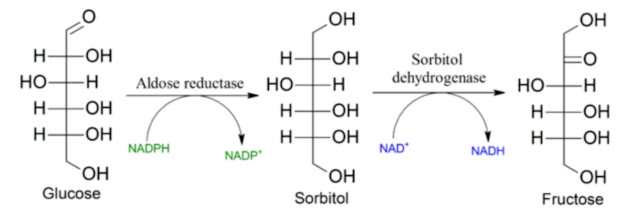
However, I did not find much; there is probably no direct effect, it is a more complex pathway. My estimate is that glycine supports the breakdown of methionine and activates H₂S production via the enzyme CSE, which S-sulfhydrates the enzyme ALDH1, which is otherwise acetylated due to activation of the polyol pathway, i.e., an overly active enzyme aldose reductase (AR). S-sulfhydration makes it possible to activate the breakdown of 4-HNE via a safe pathway to an acid, rather than via AR to signaling molecules that trigger an inflammatory response. This reduces overall oxidative stress by suppressing AR expression and reducing endogenous fructose production. That is my hypothesis. It is therefore very similar to the effects of acetate, which induces a similar effect without H₂S via activation of SIRT1, and also similar to the effects of restricting intake of non-essential amino acids, which triggers their synthesis and thus activates the necessary pathways.
But I did find some interesting studies after all. Glycine, for example, protects blood vessels against oxidative stress, against advanced glycation end products (AGEs). Researchers here compared four groups of rats: a normal population without diabetes and without glycine (Control, C), rats with a model of diabetes (D), i.e., high blood glucose levels, without added glycine (DM), and with added glycine (DG) in the water. The results are really interesting.

For example, we see that glycine significantly reduced peroxidation of polyunsaturated fats (MDA) and partially restored the level of reduced glutathione.

Glycine further protects against AGE formation by activating the enzyme GLO1, which processes methylglyoxal (MG), so protein degradation via glycation cannot take place. This is very important protection.

In another study, it is shown directly how glycine can suppress the toxicity of 4-HNE in cells of the porcine intestinal epithelium. In the presence of glycine, the cells become more resilient and do not die as easily.


Glycine (Gly) can activate the production of proteins needed to improve resistance during intoxication.


By what mechanism glycine suppresses 4-HNE toxicity and reduces oxidative stress—whether by activating protein synthesis, increasing glutathione availability, or increasing S-sulfhydration of ALDH1—we do not know exactly. It may be through many other mechanisms (update: glycine blocks AR, read here). In any case, there are situations where it works. Because we do not know the exact mechanism, it may happen that in another situation it will not work. We do not know the exact conditions, cofactors, etc. Given that it is available and its use is safe, there is no reason to avoid it as a dietary supplement.
Addenum
As one forgets older knowledge, one also forgets important things. But a coincidence reminded me that glycine is easily interchangeable in protein chains with molecules of the herbicide glyphosate. These molecules are abundant in our diet, because farmers use them, for example, to dry crops before harvesting. It seems that diluting their concentration with glycine could reduce the impact on our microbiome and digestive system.
References:
The Glycine Solution: Unlocking Health Secrets with Dr. Joel Brind
Dr. Stephanie Seneff - How Glyphosate Sneaks Into Your Proteins and Disrupts Your Body


Really interesting, thanks! Now I have good reason to continue taking collagen supplements.
ReplyDeletehttps://raypeat.com/articles/articles/gelatin.shtml
ReplyDelete