How does fatty liver develop?
In the past, fatty liver with subsequent liver cirrhosis was associated exclusively with alcohol consumption. But that is the past. The term non-alcoholic fatty liver disease (NAFLD, MASLD) emerged, where alcohol clearly could not be the cause. So what is the cause of liver damage?
A post by Chris Masterjohn on X clearly identifies choline deficiency as the main cause. The fat that is formed in the form of triglycerides simply must be packaged into VLDL particles and sent out into the body. For that, sufficient choline must be available. The production of choline requires the amino acid methionine. But what does this have to do with alcohol or other foods?
When I look at my older posts, I think we can find a number of answers there. Let’s take a look.

For example, in this post it is clearly shown that choline deficiency can be significantly promoted by a deficiency of hydrogen sulfide, produced via the enzyme CSE from sulfur-containing amino acids (CSE-KO). Even choline deficiency alone (CD diet) in the diet leads to insufficient production of hydrogen sulfide (H2S). With sufficient hydrogen sulfide, that is, with activated S-sulfhydration of enzymes, the formation of new fats can be significantly reduced.

This brings us to the issue of H2S production from sulfur-containing amino acids. The main blocker of hydrogen sulfide production appears to be insufficient activity of the enzyme ALDH2, which removes aldehydes, specifically 4-hydroxy-2-nonenal (4-HNE), a product of auto-oxidation of linoleic acid. 4-HNE is formed from it during any oxidative stress, when hydrogen peroxide levels are elevated. So it is essentially a problem of a pile of firewood and a spark. A sufficient amount of linoleic acid provides the “firewood.” Oxidative stress is the initiating “spark.” Insufficient aldehyde breakdown is the result.
The main cause of oxidative stress is suppression of antioxidant protection, loss of reduced glutathione (GSH). This occurs with deficiency of the deacetylase SIRT2. Lack of antioxidant protection produces 4-HNE from linoleic acid, which then suppresses the function of the main enzyme removing 4-HNE, namely ALDH2. 4-HNE binds to this enzyme and blocks its activity. Instead of ALDH2, another aldehyde-removing enzyme is activated, aldose reductase (AR). This has its side effects.
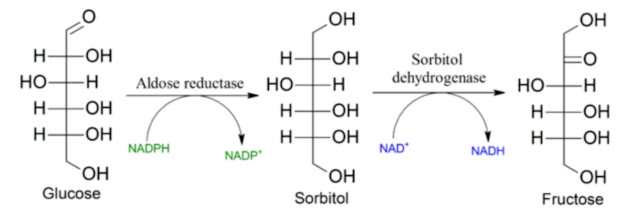
It's caused by suppression of the activity of the enzyme SIRT2! This is caused by activation of fructokinase (KHK). Where would fructose come from here? From glucose, of course! At high glucose levels and in the presence of aldehydes, aldose reductase (AR) is activated. This is the entry enzyme of the polyol pathway that converts glucose into fructose, that is, the pathway activating KHK. That is why there was a deficiency of NADPH, a deficiency of reduced glutathione (GSH), and a deficiency of H2S.

Activation of ALDH2 using ALDA1 safely removes aldehydes, without activation of AR, without fructose production, without activation of KHK. We clearly see how glucose in the presence of aldehydes reduces H2S production, whereas after restoration of ALDH2 function, glucose ensures high H2S production by the enzyme CSE, high activity of the deacetylase SIRT2, and strong antioxidant protection. The presence of aldehydes turns glucose into a poison that destroys antioxidant protection. By contrast, glucose without aldehydes behaves as an antioxidant, ensures easy recycling of glutathione, and provides maximal protection. That’s a surprise, isn’t it?
Can an aldehyde produced from alcohol (acetaldehyde, ethanal) behave similarly to 4-HNE? I think it can. Although the activation constant for acetaldehyde is many times higher, meaning that a much higher concentration must be reached, when drinking alcohol it is probably not difficult to achieve a thousand-fold higher concentration of aldehydes in the liver. This also nicely explains the interactions between foods. It is not good to combine alcohol with seed oils. Both activate AR and fructose production. It is also not good to combine alcohol with sugar, nor seed oils with sugar. All of these are foods that activate AR, KHK, that is, the polyol pathway. We should also avoid very salty and dehydrating foods. Lack of water activates AR and the polyol pathway. Equally bad is the combination of glutamate with salt and seed oils.
Perhaps inhibiting AR would help. But suppressing AR function in the presence of seed oils may lead to cancer. Aldehydes would not be degraded. Products of linoleic acid peroxidation must be eliminated. AR apparently can do this even in the presence of HNE; a better solution is probably to compensate for the effect of KHK using acetate/vinegar. We have already shown this here. Let us try to return glucose to its original function. We already know that products formed by peroxidation of omega-6 linoleic acid reverse the function of glucose from antioxidant to strongly pro-oxidative!
Addendum
The attentive reader should object that the main enzyme that breaks down 4-HNE aldehydes is the cytosolic enzyme ALDH1. This is not much affected by the concentration of 4-HNE, so it should function even after the suppression of ALDH2 activity. Its activity should actually prevent the activation of AR. Nevertheless, it seems that the function of ALDH2 must be replaced by AR, not ALDH1. Why? It seems that acetylation, i.e. insufficient function of deacetylases, specifically suppressed function of SIRT2, is responsible.
This again turns the attention to fructose and the fructokinase KHK. Without the activation of KHK, the concentration of 4-HNE could not increase and AR could not be triggered. It is a cyclical process, it acts like a switch that, once you turn it on, is then difficult to turn it off. It is, as Dr. Rick Johnson puts it, “The Fat Switch”.
But we already know how to do it. Acetate, through SIRT1, can turn this switch back off under the right conditions (e.g., protein restriction). And that's very important to know.

References:
Links to previous posts are included in the text.
NOTCH-induced aldehyde dehydrogenase 1A1 deacetylation promotes breast cancer stem cells


Comments
Post a Comment