Posts

Peroxisomes torn from the chain, how to tame them?
Image
In the  previous post , I showed you a mouse study that clearly shows that turning on pseudohypoxia, that is, activating the transcription factor HIF-1α in adipose tissue, triggers obesity and other metabolic problems. I have shown that one of the main triggers is the accumulation of succinic acid (succinate), one of the intermediates of the TCA cycle. If there are any problems with the TCA cycle (obtaining energy through oxidation), succinate builds up and triggers the HIF-1α rescue mechanism , fat cells get bigger and stop working properly. So the question is how to prevent this? How to reduce the risk of succinate accumulation? How to ensure stable and sufficient breakdown of succinate, i.e. the activity of succinate dehydrogenase (SDH)? Succinate content increases with increasing omega fat oxidation in peroxisomes (here added dicarboxylic acid DCA12). One of the main sources of succinate during fasting, i.e. between meals, are organelles called peroxisomes. They are bound dire...
Omega fat oxidation as a prevention of civilization diseases?

Image
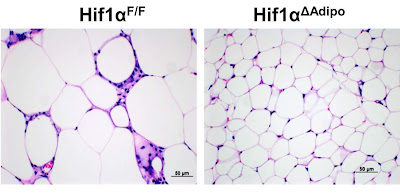
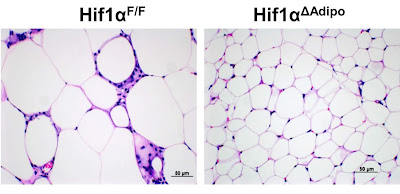
O mega oxidation of fat, what is it? You've probably never heard of this term before, in fact I think most professionals either don't know the term or have long since dismissed it as irrelevant information. I will try to explain here why I think that omega oxidation, or the insufficient activation of this metabolic process, is the root cause of civilizational diseases, including cancer. But let's start slowly. In one of the previous posts , I explained the activity of the fat cell. As long as it is not overloaded with excess fuel, free fatty acids (FFA / NEFA) or glucose, the cell works normally. If there is more fuel, it is stored as fat, if there is not enough, it releases fat into the bloodstream. Very useful activity. But studies on mice show us that if we give them a high-fat diet instead of a standard chow diet, the mice will get fat and become obese. Their fat cells will grow in size (left image), stop working properly, start to signal inflammation and releasing ex...

Pseudohypoxia again, how to turn off the correct response to lack of oxygen?

Image
I will try to follow up on several previous posts, because, as you may have already understood, inducing pseudohypoxia under conditions of relative sufficient oxygen fundamentally affects the metabolism of the cell and thus the entire organism. The main control element, the shift lever, is the presence of the transcription factor HIF-1α, which, through the control of HIF-1, turns hundreds of genes on and off to adjust the metabolism according to the current conditions. Stabilization of HIF-1α can be caused, for example, by an increased level of H2O2 or succinate (my notes in green). The termination of the T-shaped line indicates the suppression of the reaction and thus the stabilization of HIF-1α. We have also already recognized that it is not our enemy, but a helping hand. It appears whenever the cell has some problems. It typically occurs when there is a lack of oxygen, but not only that. It also occurs when there is an excess of fuel, i.e. an excess of glucose, fats, pyruvate, Acety...

Do you have an open MCT4 backdoor, or you have a low back pain?

Image
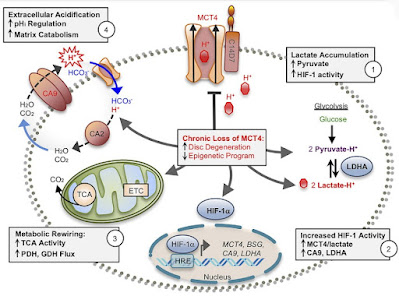
The name of this blog, MCT for health, is originally derived from the name of medium chain triglyceride, MCT oil. However, as I am gradually finding connections with lactate metabolism, it could easily be derived from MCT transporters, such a passable protein gates in cell membranes. I follow up on the previous post , which clarifies the behavior of fat cells and the causes of their dysfunction, which is manifested by a change in glucose metabolism and lactate production, thus triggering pseudohypoxia . So we explained that triggering these mechanisms in the fat cell is not desirable, but it is a rescue mechanism to deal with the extremely high insulin sensitivity caused by excessive polyunsaturated fats. Today, however, we find out that the exact same mechanism in another tissue is completely fine and beneficial. We even find that it causes problems when pseudohypoxia doesn't start, when the gates of MCT4 transporters don't open. As you can see, nature has given us processes t...

From pyruvate to lactate or from lactate to pyruvate? That is the Question!

Image
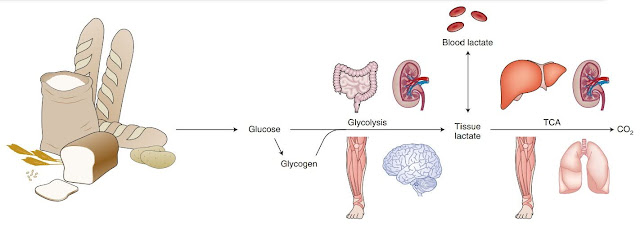
Lactic acid, or lactate (not to be confused with lactose - milk sugar) is such an ugly duckling, pushed aside. It is considered by most to be an insignificant product of tired muscles that tells us when we have had enough and that we should rest. However, this is a very narrow view. I have already mentioned here that we have an immediate supply of glucose in the blood equivalent to only about one teaspoon of sugar. It is said that we have up to 20 times more lactate in our blood! Well, I don't have proof of that, but it's certainly a fuel that needs to be reckoned with, not ignored. Every cell can convert lactate to pyruvate and vice versa. Don't you know what pyruvate is? This is a product of glucose processing in the cell. Once the cell takes in glucose, it tags it with a phosphate tag and the glucose can no longer escape from the cell. There is no going back for glucose. It will be converted to pyruvate. The fate of glucose in the cell is determined by many things. If we...

How do free fatty acids affect the severity of a heart attack?

Image
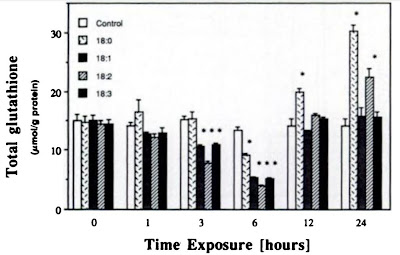
In the previous two posts , I wrote about hypoxia and pseudohypoxia, i.e. the state of lack of oxygen or just the signaling of lack of oxygen in the tissues. I predicted that free long-chain fatty acids (abbreviation FFA or NEFA), by strongly modulating the activity of the enzyme glutathione peroxidase (GPx), would likely strongly influence oxygen deficiency signaling through the transcription factor HIF-1 α  whose proper and adequate stabilization requires some, not too little or too much hydrogen peroxide H2O2. Too high a peroxide level will be typical in pseudohypoxia, and too low will cause an insufficient and therefore potentially very dangerously low response to oxygen deficiency. The two conditions can be quite intertwined and can occur simultaneously in different tissues and also the conditions will depend heavily on the specific ones in the tissue. It seems that if, for example, the heart muscle suffers from insulin  resistance and therefore also a mild pseudohypoxia,...

Aging as progressive pseudohypoxia?

Image
We have already come across the concept of hypoxia here, it is a state of lack of oxygen. Every healthy cell can prepare for this condition  just in time, can turn on and off the necessary genes, and can easily survive a short-term or moderate lack of oxygen. But what is pseudohypoxia? We can imagine it so that the cell receives a signal that there is not enough oxygen and starts the necessary mechanisms. But in reality, this signal is false and can thus damage the cell.  The same phenomenon is also referred to as aerobic glycolysis or, according to its discoverer, as the Warburg effect. The authors of one study arrived at these considerations because they noticed a striking similarity in the behavior of aged cells and cells exposed to a lack of oxygen. But let's look at another study first. Graphical abstract, hypoxia (or even lack of reduced glutathione, my note) leads to stabilization of HIF-1 α  and thus suppression of beta oxidation of fats and glucose fermentation....

How does omega-6 vegetable oil confuse our cells?

Image
It will probably be a little less digestible today, but I need to sort out my thoughts. It is time to make a small inventory of how specifically polyunsaturated vegetable oils, especially linoleic omega-6, affect cellular signaling in obtaining energy from available fuels and thus confuse the cell so much that it begins to behave completely differently than in the burning of conventional animal fats. Let us now repeat what we already know clearly about linoleic acid: It devastates our reserves of reduced glutathione (GSH). Low levels of GSH strongly suppress the activity of the first mitochondrial complex of the electron transport chain, thus suppressing the production of energy from NADH molecules. Initially, it improves insulin resistance, thus reducing H2O2 levels. It reduces the activity of the enzyme superoxide dismutase (SOD). It supports the beta-oxidation of unsaturated fats, the desaturation of saturated fats, ie the conversion of saturated fats to monounsaturated, the cleavag...